
Hostwinds Blog
Search results for:
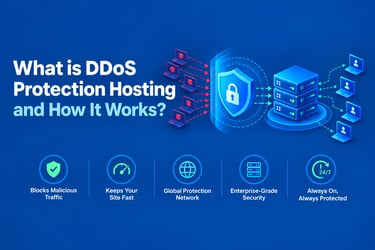
What is DDoS Protection Hosting and How It Works?
by: Hostwinds Team / October 6, 2026
If you've ever had a website go suddenly, completely offline with no obvious explanation or if you've seen the news about major services being taken down for hours, there's a good chance a DDoS attack was involved.
DDoS attacks are one of the most common and disruptive threats facing websites today. And the good news is that the right hosting setup can protect you from them automatically.
This guide explains what DDoS protection hosting is, how it works, and what to look for when choosing a host that takes this seriously.
What Is a DDoS Attack?
DDoS stands for Distributed Denial of Service. Here's what that means in plain terms.
Every website has a server that handles incoming requests when someone visits your site, their browser sends a request, your server processes it, and sends back your webpage.
A DDoS attack floods your server with an enormous volume of fake requests from hundreds, thousands, or even millions of compromised computers (called a botnet) simultaneously. The server gets overwhelmed trying to process all these requests and becomes unable to serve legitimate visitors. Your site goes down.
The "Distributed" part is what makes it hard to block: the attack traffic comes from thousands of different IP addresses. You can't just block a single source.
DDoS attacks range from small-scale disruptions lasting minutes to massive sustained attacks targeting major infrastructure for hours or days.
For more background on the mechanics of DDoS attacks, see our detailed guide: What is a DDoS Attack? Risks, Prevention, Mitigation.
How DDoS Protection Works
Good DDoS protection works at the network level, before malicious traffic ever reaches your server. Here's the general approach:
- Traffic scrubbing - Incoming traffic is analysed in real time. Legitimate traffic is allowed through. Traffic matching DDoS attack patterns is filtered out before it reaches your server.
- Rate limiting - Requests from a single source that exceed normal browsing patterns are throttled or blocked.
- IP reputation filtering - Traffic from known malicious IP addresses or botnets is blocked automatically based on threat intelligence databases.
- Anycast diffusion - Some enterprise DDoS protection systems distribute attack traffic across a global network of servers so no single point gets overwhelmed.
The best DDoS protection is transparent to legitimate visitors - your site stays fast and available while attack traffic is silently filtered out in the background.
What Is Enterprise DDoS Protection?
Consumer-grade or basic DDoS protection handles smaller attacks typically in the range of 1–10 Gbps of attack traffic.
Enterprise DDoS protection handles significantly larger attacks. Enterprise-grade systems are designed to absorb attacks measured in hundreds of Gbps or even terabits per second, the scale of attacks that target banks, government websites, and major online platforms.
Hostwinds includes enterprise-grade DDoS protection across all hosting plans, shared hosting, cloud servers, and dedicated servers. This isn't an optional add-on you pay extra for it's built into the infrastructure.
Who Needs DDoS Protection?
The short answer is: everyone with a website. But certain types of sites are more likely to be targeted:
- eCommerce businesses — Online stores are frequently targeted, either for financial gain (extortion), competitive sabotage, or to steal customer data during the confusion of an attack.
- Gaming servers and platforms — Gaming is one of the most frequently DDoS-attacked categories. Competitive rivalries, revenge attacks, and ransom attempts are common.
- Financial services — Banks, fintech platforms, and crypto exchanges are high-profile targets.
- Political and news sites — Ideologically motivated attackers target content they oppose.
- Small businesses — Contrary to common belief, small businesses are targeted too - often because attackers assume they have less protection than large enterprises.
- Any site that competes online — Competitors have been known to DDoS rivals' sites during sales events, product launches, or critical business periods.
What Happens Without DDoS Protection?
If your hosting doesn't include DDoS protection and you're hit with an attack:
- Your site goes offline
- Your server may need to be manually reset or migrated
- Downtime can last from minutes to hours depending on the attack scale and your host's response
- You may receive a suspension notice from your host for excessive bandwidth usage caused by the attack
- Revenue, customer trust, and search rankings can all be affected by extended downtime
What to Look for in a Host's DDoS Protection
When evaluating hosting providers for DDoS protection, ask these questions:
Is DDoS protection included or an add-on? The best providers include enterprise DDoS protection in all plans. Add-on protection is better than nothing but signals that it's not a priority.
What scale of attack can it handle? A host protecting against 1 Gbps attacks isn't the same as one protecting against 100 Gbps attacks.
Is it automatic? Ideal DDoS protection activates automatically without requiring you to submit a support ticket or take manual action.
What's the uptime SLA? An uptime guarantee without DDoS protection is hollow — attacks will cause downtime that the SLA doesn't cover if DDoS protection isn't part of the package.
Hostwinds and DDoS Protection
Hostwinds includes enterprise-grade DDoS protection across all hosting plans. It's part of the infrastructure, not an optional upgrade.
Combined with the 99.9999% uptime SLA, this means Hostwinds is designed from the ground up to stay online even under attack conditions that would take down less-prepared infrastructure.
For businesses in India and Canada looking for reliable hosting with built-in security, this is worth factoring in alongside uptime guarantees and pricing.
Wrapping Up
DDoS attacks are common, increasingly automated, and affect businesses of all sizes. The best defence is a hosting provider whose infrastructure absorbs attacks before they reach your server, automatically, without you having to do anything.
When evaluating hosting plans, look for enterprise DDoS protection that's included by default, not bolted on as an optional extra. Hostwinds includes this across shared hosting, cloud servers, and dedicated servers backed by a 99.9999% uptime SLA and 24/7 support.
Written by Hostwinds Team / October 6, 2026