
Hostwinds Blog
Search results for:
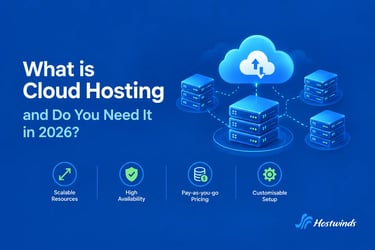
What is Cloud Hosting and Do You Need It in 2026?
by: Hostwinds Team / September 17, 2026
"Cloud hosting" is one of those terms you've probably heard a hundred times. But what does it actually mean and is it the right type of hosting for your project?
This guide breaks it down clearly: what cloud hosting is, how it works, how it's different from VPS and dedicated servers, and when it makes the most sense.
What is Cloud Hosting?
Cloud hosting is a type of web hosting where your website or application runs across a network of interconnected virtual servers rather than a single physical machine.
Instead of your site living on one server (like with traditional shared hosting, VPS, or a dedicated server), cloud hosting distributes the load across multiple servers in a cluster. If one server in the cluster has an issue, another takes over. Your site stays online.
The key characteristics of cloud hosting:
- Scalability — You can increase or decrease resources (CPU, RAM, storage) almost instantly as your needs change.
- High availability — Multiple servers means no single point of failure. If one server goes down, your workload shifts automatically.
- Pay-as-you-go flexibility — Many cloud platforms charge for what you actually use, rather than a fixed monthly fee regardless of usage.
- Customisable deployment — You choose your configuration, your operating system, your software stack.
How Is Cloud Hosting Different from VPS Hosting?
This is where people often get confused, because VPS and cloud hosting can look similar on paper.
With VPS hosting, you get a virtual private server — a dedicated portion of a single physical server's resources. Your resources are guaranteed and isolated, but they come from one machine.
With cloud hosting, your virtual server is part of a larger cloud infrastructure. The underlying compute, storage, and networking resources can span multiple physical machines in a data center or across data centers. This adds a layer of redundancy and scalability that traditional VPS can't match.
In practice, the lines have blurred. Many modern "VPS" products (including Hostwinds') run on cloud infrastructure. The key practical differences are usually around scalability, redundancy architecture, and billing model.
Hostwinds cloud servers give you a fully customizable cloud environment — you choose your CPU count, RAM, storage, operating system, and applications. You can scale resources up or down through the Cloud Portal without migrating to a new server.
Cloud Hosting vs Dedicated Server
Cloud hosting is virtual by nature. Your server is an isolated virtual environment within a larger cloud infrastructure. Multiple physical machines may contribute to your server's resources.
Dedicated servers give you a single physical machine entirely to yourself — every CPU core, every GB of RAM, every byte of storage. For maximum raw performance and complete physical isolation, dedicated is the answer.
Cloud hosting wins on flexibility and scalability. Dedicated hosting wins on raw performance and compliance requirements. For a deeper comparison, see our VPS vs dedicated server guide.
What Are Cloud Servers Used For?
Cloud servers are versatile. Common use cases include:
- Web applications and SaaS products — Applications that need flexible compute and can scale with user demand.
- eCommerce platforms — Online stores that experience traffic spikes during sales events can scale cloud resources up during peak periods and back down afterward.
- Development and staging environments — Deploy a cloud server for testing, tear it down when you're done. Pay only for what you use.
- Content delivery — Pair cloud servers with object storage and load balancers for scalable content delivery architectures.
- Database servers — Run dedicated database instances with the specific CPU and RAM allocation your workload needs.
- Game servers — Cloud servers are popular for game server hosting because you can deploy quickly and scale resources as player counts grow.
- Disaster recovery — Cloud infrastructure makes it easy to deploy backup environments and failover setups.
What Does Hostwinds Cloud Hosting Include?
Hostwinds' cloud server plans are fully customizable and include:
- Flexible resource selection — Choose your exact CPU, RAM, storage, and bandwidth configuration
- 1 Gbps network ports — High-speed connectivity for all cloud server plans
- SSD storage — Fast solid-state storage across all plans
- Snapshot tool — Take a full point-in-time snapshot of your cloud server anytime
- Firewall management — Control inbound and outbound traffic through the Cloud Portal
- Load balancers — Distribute traffic across multiple cloud server instances for high availability
- Object storage and block storage — Expandable storage options that integrate with your cloud servers
- 24/7/365 support — Live chat and ticket support around the clock
- 99.9999% uptime SLA — The same industry-leading uptime guarantee that covers all Hostwinds plans
Do You Need Cloud Hosting?
Here's a simple way to think about whether cloud hosting is right for your situation:
Probably yes, if:
- Your application needs to scale resources quickly in response to demand
- You want high availability with no single point of failure
- You're building a web application or SaaS product that could grow fast
- You want flexibility to deploy, configure, and tear down server environments quickly
- You're running multiple services that benefit from isolated, independently scalable server instances
Probably not (yet), if:
- You're running a simple website or blog, shared hosting or basic VPS is more cost-effective
- Your traffic is consistent and predictable, a VPS with fixed resources is simpler and cheaper
- You're new to hosting and want the simplest possible setup, managed shared or managed VPS is a better starting point
For a deeper look at how virtual servers work, see our guide on virtual servers, it covers the concepts behind both VPS and cloud environments.
Cloud Hosting for Users
The startup ecosystem is one of the fastest growing in the world. Cloud hosting is particularly relevant for developers and businesses because:
- It scales with growth, no need to overprovision when you're starting out
- Monthly billing means lower capital commitment for early-stage startups
- Flexible resource allocation suits the variable traffic patterns of growing businesses
- Hostwinds cloud hosting gives users access to enterprise-grade cloud infrastructure at globally competitive prices
Wrapping Up
Cloud hosting is powerful, flexible, and increasingly the default choice for applications that need to scale. The core advantages of on-demand scalability, high availability architecture, and pay-for-what-you-use flexibility, make it compelling for growing projects.
If you're building something that needs to grow, or you want an infrastructure that handles traffic spikes without manual intervention, Hostwinds cloud servers give you a fully customizable, enterprise-grade environment backed by a 99.9999% uptime SLA and 24/7 support.
Not sure whether cloud or VPS is the better fit? The easiest thing to do is reach out to Hostwinds support, the team can help you evaluate your specific situation.
Written by Hostwinds Team / September 17, 2026